


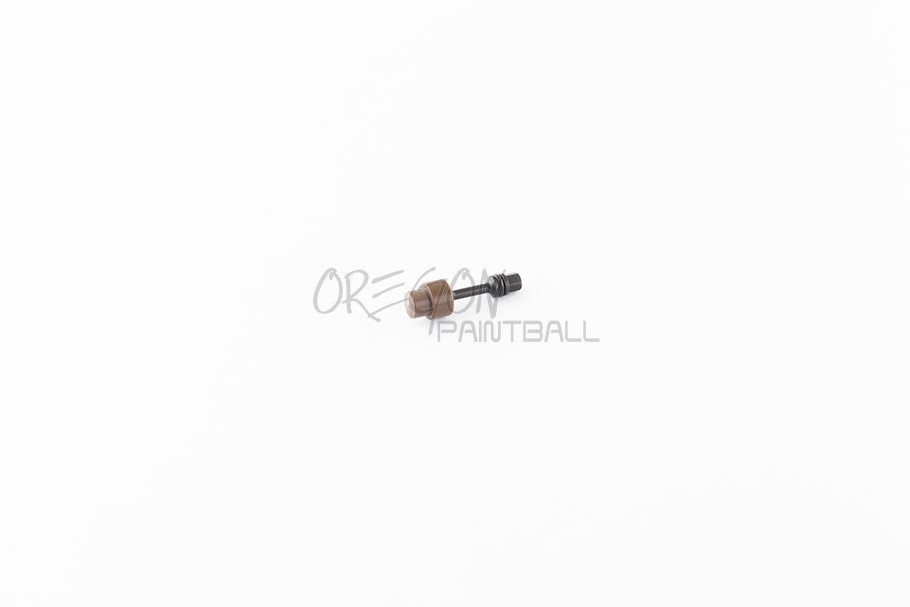
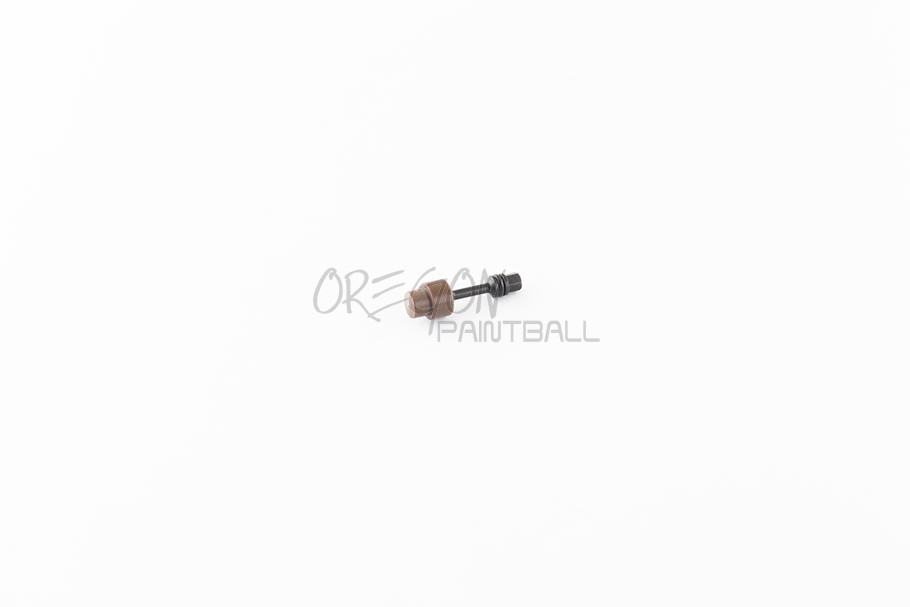
eMax Intimidator Poppet

- Description
-
Details
We are very excited to release our all new eMax Poppet System for the Gen 5 and Gen 6 Intimidator! These valves were designed with maximum efficiency in mind.
The all new eMax Poppet provides your Intimidator with the ultimate long lasting performance your marker needs. The eMax utilizes a hard brown impregnated POM material instead of straight Teflon or O-ring sealing options. By utilizing this harder material we can keep the stroke of your Intimidator consistent throughout the life of your poppet top making your marker more consistant with less regulator tuning. The new eMax poppet keeps your stroke sealing in the same place rather than moving over time changing all other aspects of your marker providing unprecedented repeatability and longevity. All our eMax Poppet valves are made with pride in the USA!
We offer different strokes for different folks. If you’re looking for maximum shot count then install the Gold shaft. If you’re looking for softer shot sound and slight lower LPR pressure then select the black shaft.
Each poppet includes brief installation guide for help although if customers want us to install for them please send in your marker and we will install free of charge (customer covers shipping.)
Checkout our video tour below and for an even deeper dive you can nerd out with the engineer in our white paper below.
Benefits:
- Stem Lengths- Offering 2 different stem lengths: Gold (standard stroke) and Black (extended stroke.) Gold built for maximum total shot count, while black will deliver softer shot and slightly lower LPR pressure
- New Cup Seal- Newly designed PTFE Impregnated POM poppet top gives the best possible constistency over the length of the poppet
- Efficiency- Will provide a more efficient shot, especially over extended periods of time
- Break away- Provides the cleanest, quickest breakaway for the platform
- Longevity- The hardness of the material allows the tops to last longer then a standard O-ring or straight teflon.
- Instructions- Includes installation instructions with each poppet.
- MADE IN USA
Youtube Video Link: eMax Poppet.A Word from the Engineer
Efficiency
There are many rules to follow when designing markers for efficiency. A poppet valve style marker is always a great starting point for a gas efficient platform. When it comes to the poppet valve itself, there are many factors which govern efficiency. Operating pressure, surface areas of components, gas path, passage volume, stroke (open max.) and duration are just some examples. One often overlooked factor I deem highly important is material selection for the primary sealing element. My philosophy here has always been: choose the hardest material that will seal reliably.
The primary reason for selecting a harder material is to force a cleaner, faster “break-away” upon valve opening. The faster you can impart energy toward accelerating a paintball the more efficient your pneumatic system will be. Softer elastomeric materials seal under the worst of ideals yet always suffer excess stiction. Gas transfer during “break-away” is extremely violent and will abrade the softest of materials over time.
The best material for sealing against sub-optimal surfaces would of course be elastomeric, such as an O-ring or molded/sheet polyurethane. Those choices will always be most forgiving when sealing against irregular or damaged surfaces. Teflon, by comparison is much harder and a good “middle ground” solution but has two attributes which must be taken into consideration. The first thing to know about Teflon (PTFE) is that it will thermally expand. The second and most pertinent is compression set. Because PTFE is a softer plastomer it will excessively cold flow (creep), causing any sealing interface to change geometry with extended use. Reformed interface geometry will introduce more stiction and hinder efficient “break-away”.
A Little History
PTFE was used for the primary sealing element in Gen5 and Gen6 Intimidator poppet valves. This was the best compromise for an effective/durable seal that could handle any manufacturing irregularities. Both platforms were designed around a “radius on radius” sealing interface. Gen5 markers utilize turned valve guides while Gen6 guides were milled into the rear Mainbody section. A slightly larger valve seat radius was used on the Gen6 platform for manufacturing reasons. That being said, both platforms utilize the exact same poppet seal and shaft.
Two poppet seal/shaft assemblies were offered. Gen5 and Gen6 markers shipped with the standard length poppet shaft providing a stroke (open max.) of about 0.100” with the shaft being made from brass. The aftermarket “low pressure” offering had a stroke (open max.) of about 0.130” and the shaft was made from stainless steel. There was no mechanical advantage to using stainless steel but a visual difference between the two assemblies was needed so customers could easily distinguish.
Material
The material I chose for this poppet application is PTFE impregnated POM. This material can be acquired with PTFE fiber or powder-fill. I’ve done exhaustive testing with the fiber-filled variant, only PTFE powder-filled POM meets the engineering requirements. This material machines well allowing us achieve the surface finish needed for a reliable interface. I have deployed this material in several sealing applications over the years with a solid track record for success. The one caveat being interface components must be made to the highest standard to avoid gas leakage.
Installation
For maximum shot count we recommend installing the “standard” stroke (gold shaft) eMax Poppet. The “extended” stroke (black shaft) eMax Poppet will deliver a softer shot but at the sacrifice of around a hopper per fill (70ci) worth of efficiency. Internal testing has shown eMax Poppets to be more efficient than their PTFE counterparts; however, formal testing for publication is still underway.
Gen5 Intimidator installs should be a straight forward swap. So long as the valve seat radius has not been damaged, your new eMax Poppet should seal right up and be ready to run. A damaged valve seat radius is the primary reason for a persistently leaking poppet seal. The critical sealing radius can be damaged by passing debris, improper handling or the re-anodization process. Most often though, damage occurs during “tech” by dropping poppet valves into place as opposed to lowering them carefully, so please take note and use care.
Gen6 Intimidators pose a greater challenge to installation success. Again, the slightly larger (than Gen5) valve seat radius was milled directly into the rear Mainbody section via interpolation. CNC interpolation is a fairly accurate process on tight machine tools but will never best turning for true roundness. Thousands of units were produced by four different vendors on various CNC machines so variance must be assumed. Damaged valve seats are a far worse problem in the Gen6 platform because a replacement rear Mainbody section is needed for proper repair. Providing the valve seat radius has no damage, your eMax Poppet may seal right away with no further intervention. However, most Gen6 eMax installs will require an extra seating process prior to deployment. For this process, please follow the installation instructions included with your Gen5/6 eMax Poppet.
Finally, it’s important to state there may be a small sampling of “undamaged” Gen6 valve seats that will never fully seal (mean operating pressure) against the harder eMax material. This has yet to present in testing but must be acknowledged. Statistical acceptance can be frustrating but should be par for the course when chasing bleeding edge performance gains.End of Note.
- Specifications
-
Additions
Manufacture Blast Warranty 30 days Weight 0.01oz Sku blast-100-2406 Compatibility Gen 5 & 6 Intimidators - Reviews
-
Add Your Review


